Learning Science
Why EdSutra's learning companion is a cat: the research behind Ada
By Dr. Sai Gattupalli · · 5 min read
What four decades of research on learning companions suggest, and why EdSutra's companion is a scripted pixel cat rather than a chatbot.
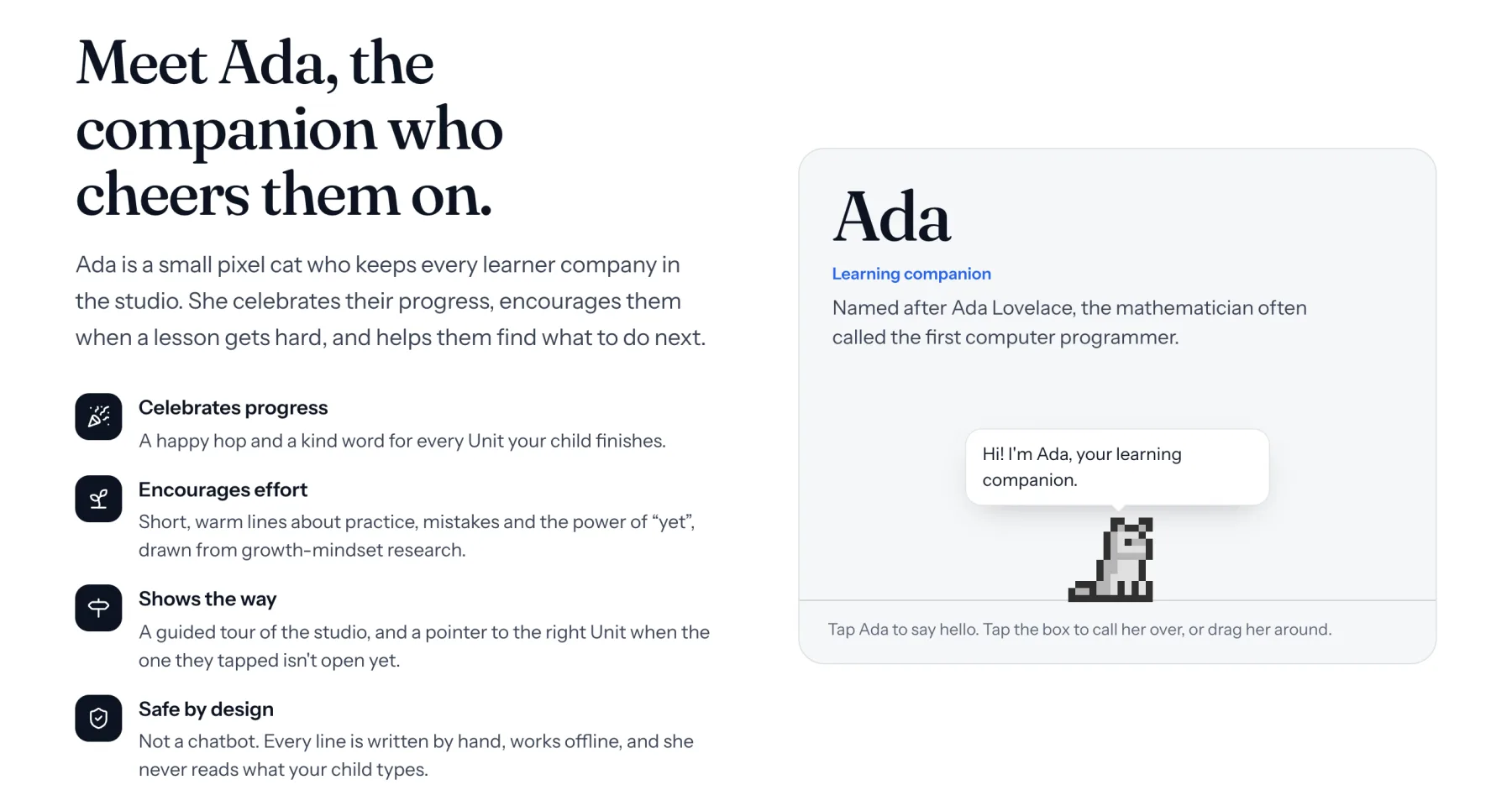
Every learner in EdSutra Studio has company. Ada, a small pixel-art cat, sits on the learner's card at the edge of the screen. She celebrates each finished Unit, offers a guided tour, and when a learner taps a Unit that is not open yet, she points to the one to do first. This essay sets out the research that shaped her, the design decisions that follow from it, and why, in a curriculum about artificial intelligence, our companion is deliberately not an AI.
A brief history of the learning companion
The idea is older than the web. In 1988, Tak-Wai Chan and Arthur Baskin proposed a tutoring system with three participants rather than two: a computer teacher, a human student, and a computer companion who learned alongside the student. Their title borrowed a Chinese story of a child who studied beside a prince. The companion's role was not to know the answers but to share the work: to collaborate, to compete a little, and sometimes to be wrong.
A decade later, James Lester and his colleagues reported what they called the persona effect: in their study, the presence of a lifelike animated character in a learning environment had a strong positive effect on how students perceived their learning experience. Yanghee Kim and Amy Baylor later gave the field a theoretical footing, grounding learning companions in social-cognitive theory. People learn from social models and are motivated by them, and a well-designed agent can play that part.
What the evidence shows, and what it does not
For a time, enthusiasm outran evidence. Heidig and Clarebout's 2011 review of the empirical research found the effects of pedagogical agents on motivation and learning to be mixed: some designs helped, others made no difference, and what decided the matter was how an agent was designed and what it was asked to do. Schroeder, Adesope and Gilbert's 2013 meta-analysis of 43 studies found a small but significant positive effect on learning overall. The benefit was larger for school-age learners than for university students, and agents that communicated through on-screen text did better than those that narrated aloud.
There is also a well-documented risk. Harp and Mayer showed that seductive details, material that is interesting but irrelevant to the lesson, can damage learning by drawing attention away from what matters. An animated character is a seductive detail waiting to happen.
A fair reading of the literature is therefore conditional. A companion helps when it supports motivation and orientation without competing with the material for attention. It hurts when it becomes the show.
Four design decisions
The simulation teaches; the companion accompanies. Baylor and Kim designed and tested agents in three instructional roles: the expert, the motivator and the mentor. Ada is a motivator. She never explains a concept or supplies an answer. The content lives in the simulation, and progress depends on the learner's own evidence. A companion that knew the answers would quietly undermine a curriculum built on predicting, testing and being surprised. Reviewing that work a decade later, Kim and Baylor observed that scripted agents played their intended roles well without being especially intelligent.
Praise the process, not the person. In a classic series of experiments, Mueller and Dweck found that children praised for their intelligence persisted less after failure than children praised for their effort. Ada's lines are written accordingly. She celebrates practice, strategy and the word “yet”, and her prompts borrow from Jeannette Wing's account of computational thinking: break the problem down, look for the pattern, take it one step at a time.
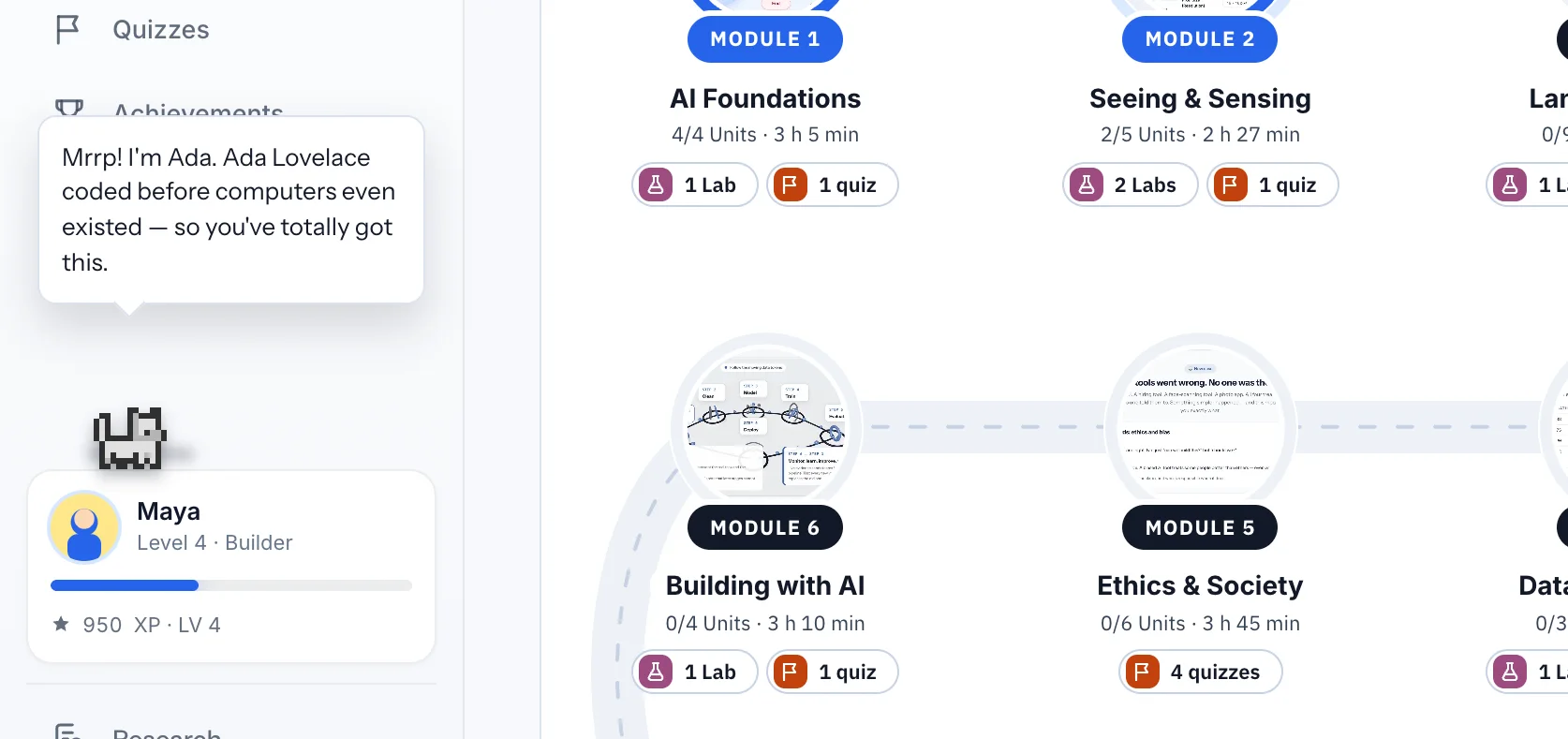
Stay at the edge of attention. Ada lives on the learner card in the sidebar, not on top of the lesson. When a Unit is finished she celebrates in place with a couple of hops; she does not walk into the activity. She stays out of the Labs entirely, and with reduced animations switched on in Settings, her tour runs without the walking and jumping.
Point, don't push. Ada's guidance is brief and spatial. On request, she gives a guided tour of the studio. When a learner taps a Unit that is still locked, she hops to the Unit that comes first. She never nags, counts down or withholds anything.
Why a cat, and not a person or a chatbot
The most consequential decision was what Ada is not. In a curriculum whose purpose is to help young people see AI clearly, a humanlike conversational companion would model the very confusion we are trying to dispel. Joseph Weizenbaum's ELIZA showed in the 1960s how readily people attribute understanding to a program that only matches patterns. Half a century later, Stefania Druga and her colleagues found that children talking with voice assistants and social robots readily attributed intelligence and personality to them.
So Ada is not a language model. She cannot be asked questions, she never reads what a learner types, and she works offline. Every line in her repertoire was written by a person, and she says so herself: “I'm not a chatbot — just your biggest fan.” A learner can enjoy her company without wondering what she understands. She understands nothing, and that is the honest answer.
A human figure would raise a different problem. A drawn teacher has an age, a gender, an apparent background and an air of authority, and research on agent design, Kim and Baylor's among it, shows that learners notice and respond to such cues. An animal sidesteps the question of whose face stands for expertise, and casts the companion as a peer rather than an instructor, which is the role Chan and Baskin had in mind.
Why a cat in particular? Partly for reasons of craft. A small, low-resolution pixel animal is unmistakably not a person, which keeps it well clear of the uncanny valley that Masahiro Mori described, and it can sit, nap and celebrate in a 96-pixel square without demanding attention. Partly for reasons of temperament: cats are curious, independent and unbothered by mistakes, which is the disposition we hope learners bring to a machine that has just surprised them. And partly because a cat is simply good company.
What we do not yet know
No study has compared a cat with a human figure, or a scripted companion with a conversational one, for learners using EdSutra. Ada is a design argument grounded in evidence, not a demonstrated effect, and we hold her to the standard the literature suggests: she should support persistence and orientation without costing attention. If you run a classroom study and want to examine those questions, we would welcome the collaboration at research@edsutra.com.
Ada is named after Ada Lovelace, whose notes of 1843 contain the first serious argument about what a computing machine can and cannot originate. We tell that story in Ada Lovelace and the first question of AI literacy.
References
- Baylor, A. L., & Kim, Y. (2005). Simulating instructional roles through pedagogical agents. International Journal of Artificial Intelligence in Education, 15, 95–115.
- Chan, T.-W., & Baskin, A. B. (1988). “Studying with the prince”: The computer as a learning companion. In Proceedings of the International Conference on Intelligent Tutoring Systems (pp. 194–200). Montreal, Canada.
- Druga, S., Williams, R., Breazeal, C., & Resnick, M. (2017). “Hey Google is it OK if I eat you?”: Initial explorations in child-agent interaction. In Proceedings of the 2017 Conference on Interaction Design and Children (pp. 595–600). ACM. https://doi.org/10.1145/3078072.3084330
- Harp, S. F., & Mayer, R. E. (1998). How seductive details do their damage: A theory of cognitive interest in science learning. Journal of Educational Psychology, 90(3), 414–434.
- Heidig, S., & Clarebout, G. (2011). Do pedagogical agents make a difference to student motivation and learning? Educational Research Review, 6(1), 27–54. https://doi.org/10.1016/j.edurev.2010.07.004
- Kim, Y., & Baylor, A. L. (2006). A social-cognitive framework for pedagogical agents as learning companions. Educational Technology Research and Development, 54(6), 569–596.
- Kim, Y., & Baylor, A. L. (2016). Research-based design of pedagogical agent roles: A review, progress, and recommendations. International Journal of Artificial Intelligence in Education, 26(1), 160–169. https://doi.org/10.1007/s40593-015-0055-y
- Lester, J. C., Converse, S. A., Kahler, S. E., Barlow, S. T., Stone, B. A., & Bhogal, R. S. (1997). The persona effect: Affective impact of animated pedagogical agents. In Proceedings of the ACM SIGCHI Conference on Human Factors in Computing Systems (pp. 359–366). ACM.
- Mori, M. (2012). The uncanny valley (K. F. MacDorman & N. Kageki, Trans.). IEEE Robotics & Automation Magazine, 19(2), 98–100. (Original work published 1970)
- Mueller, C. M., & Dweck, C. S. (1998). Praise for intelligence can undermine children's motivation and performance. Journal of Personality and Social Psychology, 75(1), 33–52.
- Schroeder, N. L., Adesope, O. O., & Gilbert, R. B. (2013). How effective are pedagogical agents for learning? A meta-analytic review. Journal of Educational Computing Research, 49(1), 1–39. https://doi.org/10.2190/EC.49.1.a
- Weizenbaum, J. (1966). ELIZA—A computer program for the study of natural language communication between man and machine. Communications of the ACM, 9(1), 36–45.
- Wing, J. M. (2006). Computational thinking. Communications of the ACM, 49(3), 33–35.
More from the EdSutra blog
- EdSutra Studio is now open to everyone Product · October 28, 2026
EdSutra Studio's public release: a simulation-based AI literacy curriculum for ages 11 and up. Module 1 is free; the full studio is one purchase. - Ada Lovelace and the first question of AI literacy History · October 28, 2026
In 1843 Ada Lovelace asked whether a machine can originate anything. Why her question is where AI literacy begins, and why our companion bears her name. - Introducing EdSutra Studio: a hands-on AI literacy studio in your browser Product · July 10, 2026
Interactive simulations, live labs, and a game-like curriculum that teaches how AI actually works — no installs, no accounts, one purchase. - UNESCO says every student needs AI competency. Here's what that actually asks of us Learning Science · July 6, 2026
A plain-language read of UNESCO's AI Competency Framework for Students: its four dimensions, three levels, and what they ask of curriculum builders. - Why most AI curricula fail the students they were written for Learning Science · June 28, 2026
Vocabulary lists, dated screenshots, and no machinery to touch: the three failure modes of first-generation AI literacy, and what to build instead. - Real AI labs, zero installs: why EdSutra runs entirely in your browser Product · June 20, 2026
Computer vision with your webcam, neural networks you can train, on-device models: all of it runs locally and offline, with nothing to set up. - Buy once, own forever: why EdSutra will never be a subscription Product · June 14, 2026
One payment for the core studio, optional expansions for applied tracks, and a promise: nothing you bought ever stops working. - Teach the history: why AI's past is the most useful lesson in the curriculum Curriculum · June 8, 2026
AI has boomed and crashed before. Students who know that history read today's headlines differently, so Module 1 opens with a map of where AI came from.