Learning Science
UNESCO says every student needs AI competency. Here's what that actually asks of us
· 1 min read
A plain-language read of UNESCO's AI Competency Framework for Students: its four dimensions, three levels, and what they ask of curriculum builders.
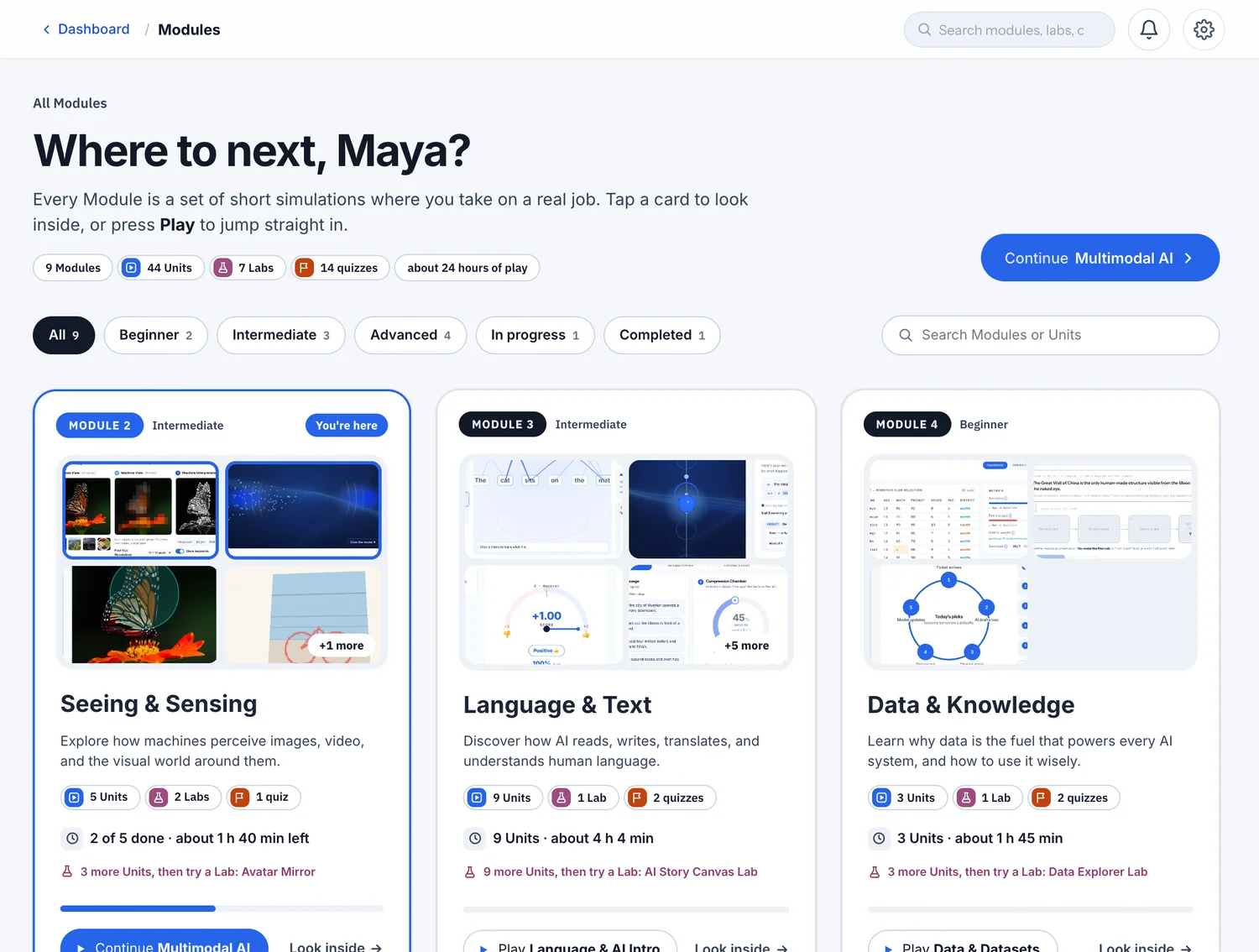
In 2024, UNESCO published its AI Competency Framework for Students — the first global attempt to define what every young person should understand about artificial intelligence. National curricula from Europe to India are now being rewritten around it. It deserves a careful read, because it asks for much more than 'teach kids about chatbots.'
Four dimensions, not one
- A human-centred mindset — seeing AI as a human-built tool that serves human goals, not an oracle.
- Ethics of AI — bias, fairness, accountability, and the environmental cost of computation.
- AI techniques and applications — how the systems actually work: data, learning, models, limits.
- AI system design — moving from consuming AI to shaping and building it.
Notice what that list does: it refuses to separate the technical from the ethical. A student who can explain gradient descent but can't spot a biased dataset is not AI-competent — and neither is the reverse.
Three levels: Understand, Apply, Create
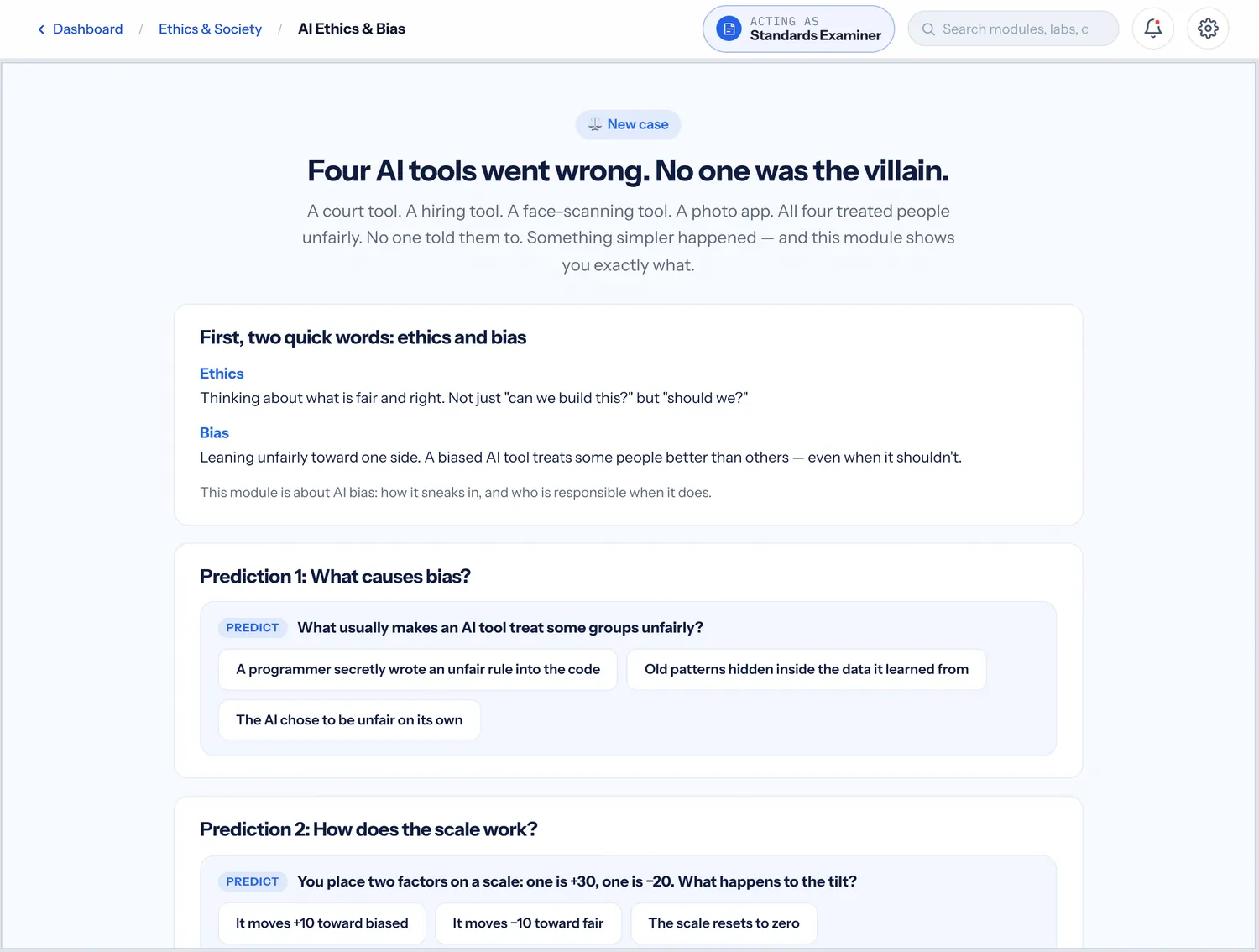
The framework's progression — Understand, then Apply, then Create — will look familiar to anyone who knows Bloom's taxonomy. It's a ladder of agency: first you can explain the system, then you can use it deliberately, then you can build and critique it. Most 'AI literacy' content today never leaves the first rung.
What this demands from curriculum
You cannot teach Apply and Create with slideshows. If students are supposed to interrogate a classifier's mistakes, they need a classifier that actually makes mistakes in front of them. That conviction is why every EdSutra module is built around a working simulation, and why we map every learning objective against the framework's dimensions when we design a unit.
Competency is not knowing what AI is. It's knowing what to do when AI is wrong.
More from the EdSutra blog
- How Bloom's taxonomy is built into every Unit Learning Science · November 5, 2026
Six kinds of thinking, climbed in order on evidence: what the revised taxonomy does inside an EdSutra Unit, from naming the parts to building your own. - EdSutra Studio is now open to everyone Product · October 28, 2026
EdSutra Studio's public release: a simulation-based AI literacy curriculum for Grade 6 and up. Module 1 is free; the full studio is one purchase. - Why EdSutra's learning companion is a cat: the research behind Ada Learning Science · October 28, 2026
What four decades of research on learning companions suggest, and why EdSutra's companion is a scripted pixel cat rather than a chatbot. - Ada Lovelace and the first question of AI literacy History · October 28, 2026
In 1843 Ada Lovelace asked whether a machine can originate anything. Why her question is where AI literacy begins, and why our companion bears her name. - Introducing EdSutra Studio: a hands-on AI literacy studio in your browser Product · July 10, 2026
Interactive simulations, live labs, and a game-like curriculum that teaches how AI actually works — no installs, no accounts, one purchase. - Why most AI curricula fail the students they were written for Learning Science · June 28, 2026
Vocabulary lists, dated screenshots, and no machinery to touch: the three failure modes of first-generation AI literacy, and what to build instead. - Real AI labs, zero installs: why EdSutra runs entirely in your browser Product · June 20, 2026
Computer vision with your webcam, neural networks you can train, on-device models: all of it runs locally and offline, with nothing to set up. - Buy once, own forever: why EdSutra will never be a subscription Product · June 14, 2026
One payment for the core studio, optional expansions for applied tracks, and a promise: nothing you bought ever stops working. - Teach the history: why AI's past is the most useful lesson in the curriculum Curriculum · June 8, 2026
AI has boomed and crashed before. Students who know that history read today's headlines differently, so Module 1 opens with a map of where AI came from.