Learning Science
Why most AI curricula fail the students they were written for
By Dr. Sai Gattupalli · · 1 min read
Vocabulary lists, dated screenshots, and no machinery to touch: the three failure modes of first-generation AI literacy, and what to build instead.
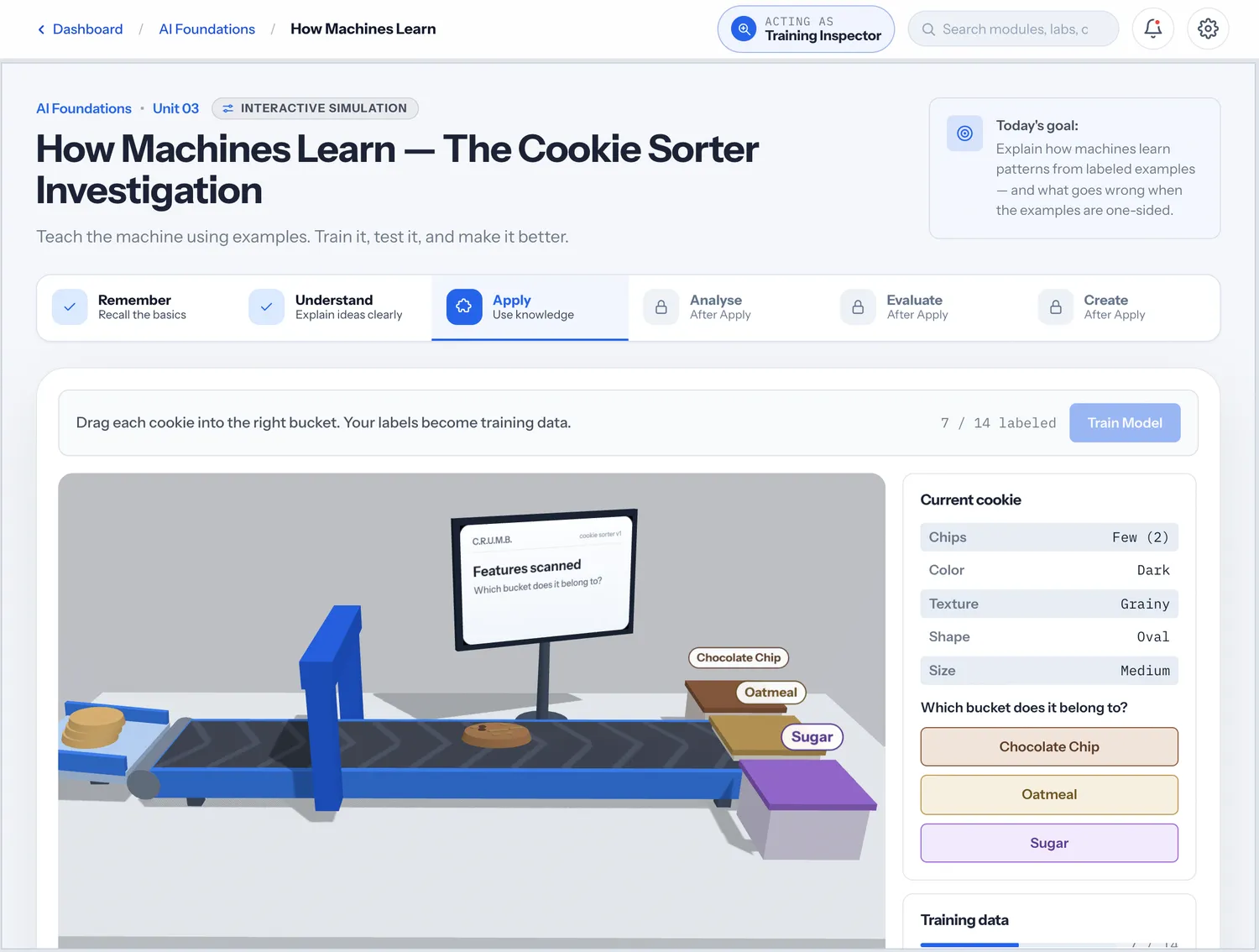
The demand for AI education is exploding, and the supply is mostly documents: slide decks, vocabulary worksheets, and video playlists assembled in a hurry. Having spent years in education technology research, we think first-generation AI curricula share three failure modes — and all three are fixable.
Failure one: teaching the words, not the machine
Students memorize that 'a neural network has layers' the way they'd memorize a capital city. Ask them what a layer does and the answer collapses. Terms without mechanisms produce the illusion of knowledge — students can pass the quiz and still believe the chatbot is thinking.
Failure two: aging faster than the textbook cycle
Any curriculum built on screenshots of specific products is obsolete in eighteen months. What doesn't age: how learning from data works, why models inherit bias, what confidence scores mean, why more compute changed everything. Teach the invariants and current events become worked examples instead of the syllabus.
Failure three: no way to be wrong
Real understanding is built by making predictions and being surprised. A lecture can't surprise you. If a student never watches their own trained model fail on an edge case — never gets fooled by a shortcut feature, never sees the confident wrong answer — they've learned about AI the way you can learn about swimming from a poster.
What we build instead
- Working mechanisms at the center of every lesson — trainable, breakable, inspectable.
- Predict-before-reveal at every step, so being wrong is a feature of the lesson, not a failure of the student.
- Bloom's ladder from Remember to Create, matching UNESCO's Understand → Apply → Create progression.
- Plain language with the technical terms one tap away — jargon explained, never dodged.
That's the standard we hold EdSutra to. Read about the approach on our AI Foundations page, or try the free Foundations Module and get fooled by a cookie-sorting machine yourself.
More from the EdSutra blog
- EdSutra Studio is now open to everyone Product · October 28, 2026
EdSutra Studio's public release: a simulation-based AI literacy curriculum for ages 11 and up. Module 1 is free; the full studio is one purchase. - Why EdSutra's learning companion is a cat: the research behind Ada Learning Science · October 28, 2026
What four decades of research on learning companions suggest, and why EdSutra's companion is a scripted pixel cat rather than a chatbot. - Ada Lovelace and the first question of AI literacy History · October 28, 2026
In 1843 Ada Lovelace asked whether a machine can originate anything. Why her question is where AI literacy begins, and why our companion bears her name. - Introducing EdSutra Studio: a hands-on AI literacy studio in your browser Product · July 10, 2026
Interactive simulations, live labs, and a game-like curriculum that teaches how AI actually works — no installs, no accounts, one purchase. - UNESCO says every student needs AI competency. Here's what that actually asks of us Learning Science · July 6, 2026
A plain-language read of UNESCO's AI Competency Framework for Students: its four dimensions, three levels, and what they ask of curriculum builders. - Real AI labs, zero installs: why EdSutra runs entirely in your browser Product · June 20, 2026
Computer vision with your webcam, neural networks you can train, on-device models: all of it runs locally and offline, with nothing to set up. - Buy once, own forever: why EdSutra will never be a subscription Product · June 14, 2026
One payment for the core studio, optional expansions for applied tracks, and a promise: nothing you bought ever stops working. - Teach the history: why AI's past is the most useful lesson in the curriculum Curriculum · June 8, 2026
AI has boomed and crashed before. Students who know that history read today's headlines differently, so Module 1 opens with a map of where AI came from.