Curriculum
Teach the history: why AI's past is the most useful lesson in the curriculum
By Dr. Sai Gattupalli · · Updated · 2 min read
AI has boomed and crashed before. Students who know that history read today's headlines differently, so Module 1 opens with a map of where AI came from.
Every student today is growing up inside an AI boom. Few of them know it's the third one. The field's history — grand promises in 1956, collapse into the first AI Winter by 1973, the expert-systems gold rush of the 1980s, a second winter, then the data-and-learning breakthrough that powers everything since — is usually a footnote. We think it belongs near the start.
History as a thinking tool
The point of teaching AI history isn't nostalgia. It's pattern recognition. Both winters had the same cause — promises outrunning what the mechanism could really do — and both ended the same way: someone changed the mechanism, not the marketing. A student who owns that pattern has a lens for every AI headline they'll ever read.
So we made it a map
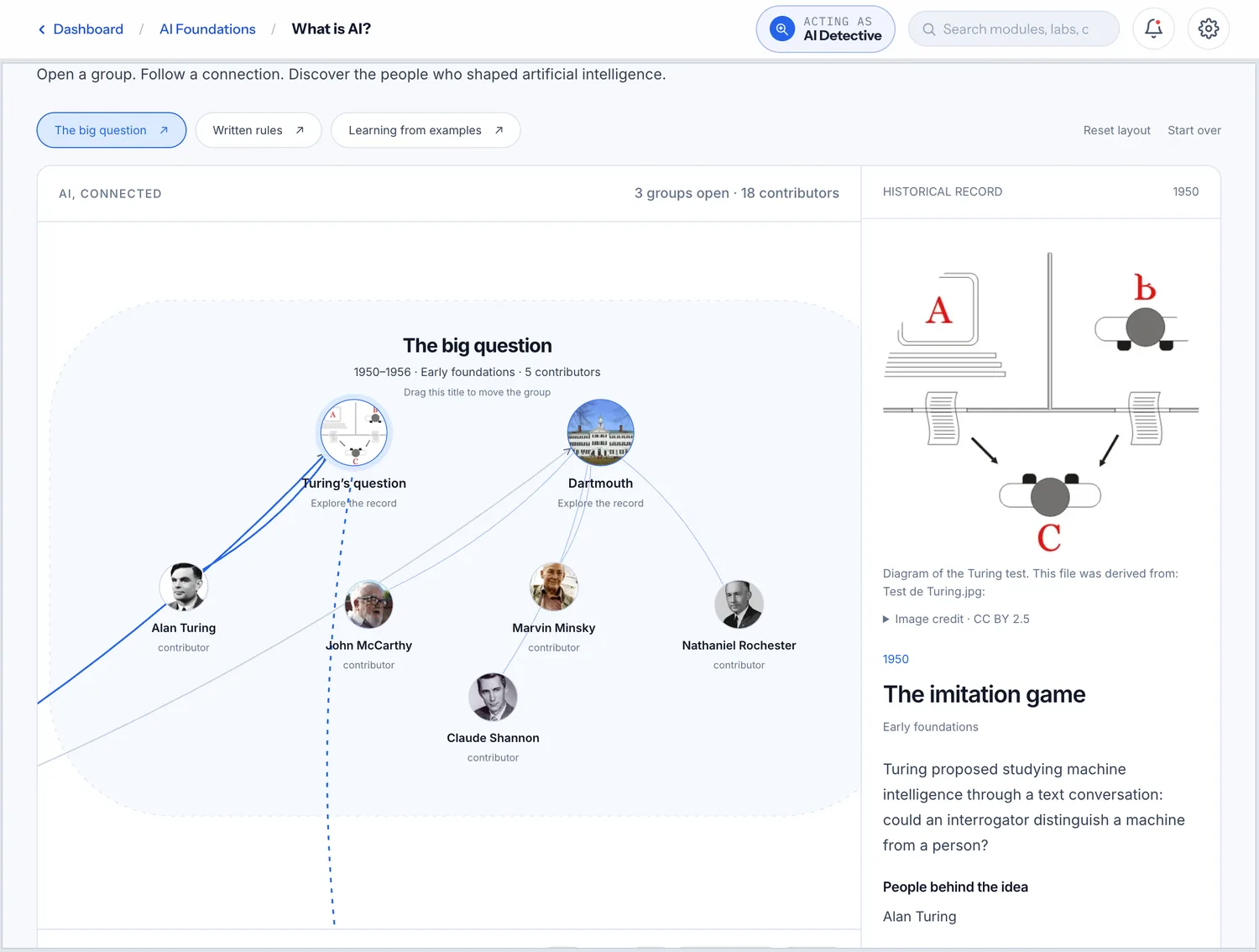
In What is AI?, the second Unit of Module 1, learners open a map of AI's big ideas and the people behind them: Alan Turing's 1950 question, the 1956 Dartmouth workshop, ELIZA's rules, Deep Blue's search, the perceptron, backpropagation, ImageNet, AlexNet, Transformers and AlphaGo. Each milestone's record gives the date, the team and a source, plus a note on what that result did not prove.
Learners follow the links between ideas to see how written rules, learning from examples and search fit together, and how often one system combines them. ELIZA held conversations without understanding a word. ImageNet depended on the people who labelled its pictures. AlphaGo paired learned patterns with search.
A chess victory is evidence of chess performance. It does not demonstrate human-level ability across all tasks.
That's the historical perspective we want: humble, mechanistic, and alert to the gap between promise and mechanism. A boom is not a mechanism, and neither is a winter. The history starts earlier than Turing, too: read Ada Lovelace and the first question of AI literacy.
Updated 23 October 2026: this post first described Origins of AI, an earlier version of this Unit built as a timeline of events with the AI winters marked on it. What is AI? replaced it in October. The argument above hasn't changed.
More from the EdSutra blog
- EdSutra Studio is now open to everyone Product · October 28, 2026
EdSutra Studio's public release: a simulation-based AI literacy curriculum for ages 11 and up. Module 1 is free; the full studio is one purchase. - Why EdSutra's learning companion is a cat: the research behind Ada Learning Science · October 28, 2026
What four decades of research on learning companions suggest, and why EdSutra's companion is a scripted pixel cat rather than a chatbot. - Ada Lovelace and the first question of AI literacy History · October 28, 2026
In 1843 Ada Lovelace asked whether a machine can originate anything. Why her question is where AI literacy begins, and why our companion bears her name. - Introducing EdSutra Studio: a hands-on AI literacy studio in your browser Product · July 10, 2026
Interactive simulations, live labs, and a game-like curriculum that teaches how AI actually works — no installs, no accounts, one purchase. - UNESCO says every student needs AI competency. Here's what that actually asks of us Learning Science · July 6, 2026
A plain-language read of UNESCO's AI Competency Framework for Students: its four dimensions, three levels, and what they ask of curriculum builders. - Why most AI curricula fail the students they were written for Learning Science · June 28, 2026
Vocabulary lists, dated screenshots, and no machinery to touch: the three failure modes of first-generation AI literacy, and what to build instead. - Real AI labs, zero installs: why EdSutra runs entirely in your browser Product · June 20, 2026
Computer vision with your webcam, neural networks you can train, on-device models: all of it runs locally and offline, with nothing to set up. - Buy once, own forever: why EdSutra will never be a subscription Product · June 14, 2026
One payment for the core studio, optional expansions for applied tracks, and a promise: nothing you bought ever stops working.