Product
EdSutra Studio is now open to everyone
By Dr. Sai Gattupalli · · 4 min read
EdSutra Studio's public release: a simulation-based AI literacy curriculum for ages 11 and up. Module 1 is free; the full studio is one purchase.
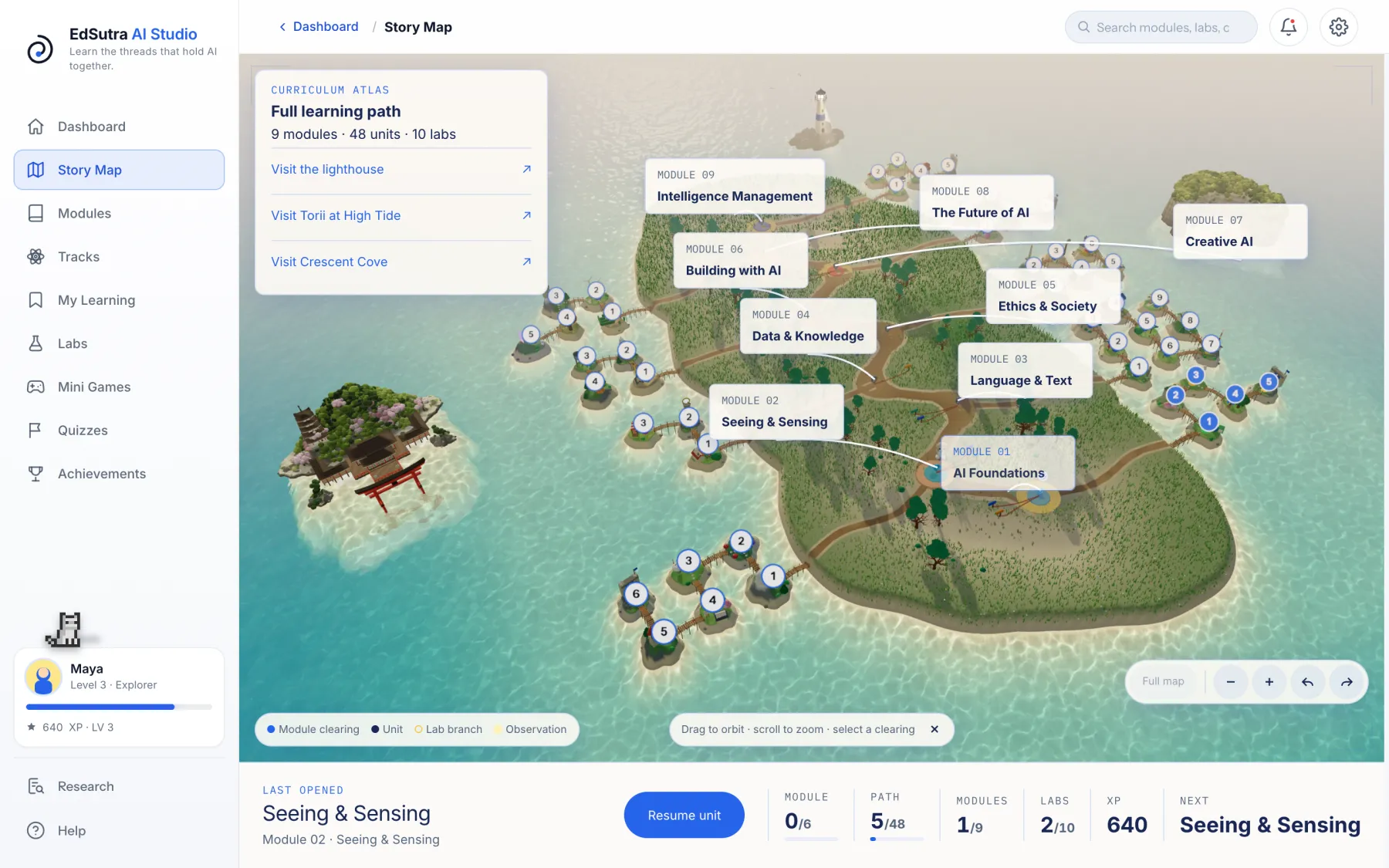
Today EdSutra Studio opens to the public. It is a complete AI literacy curriculum for learners aged 11 and up, from middle school onward: 9 modules and 44 Units, a set of open-ended Labs, and a 3D map of the whole course. It runs in an ordinary web browser, with nothing to install and no account to create.
This note sets out what is available, the premise behind it, and the commitments we make to the families and schools who use it.
What is available today
- Module 1, AI Foundations, free for everyone: no account, no card and no trial clock.
- Every other Module, Unit and Lab for one payment of $99, covering one learner, on up to 3 of their computers, with every future core Unit included.
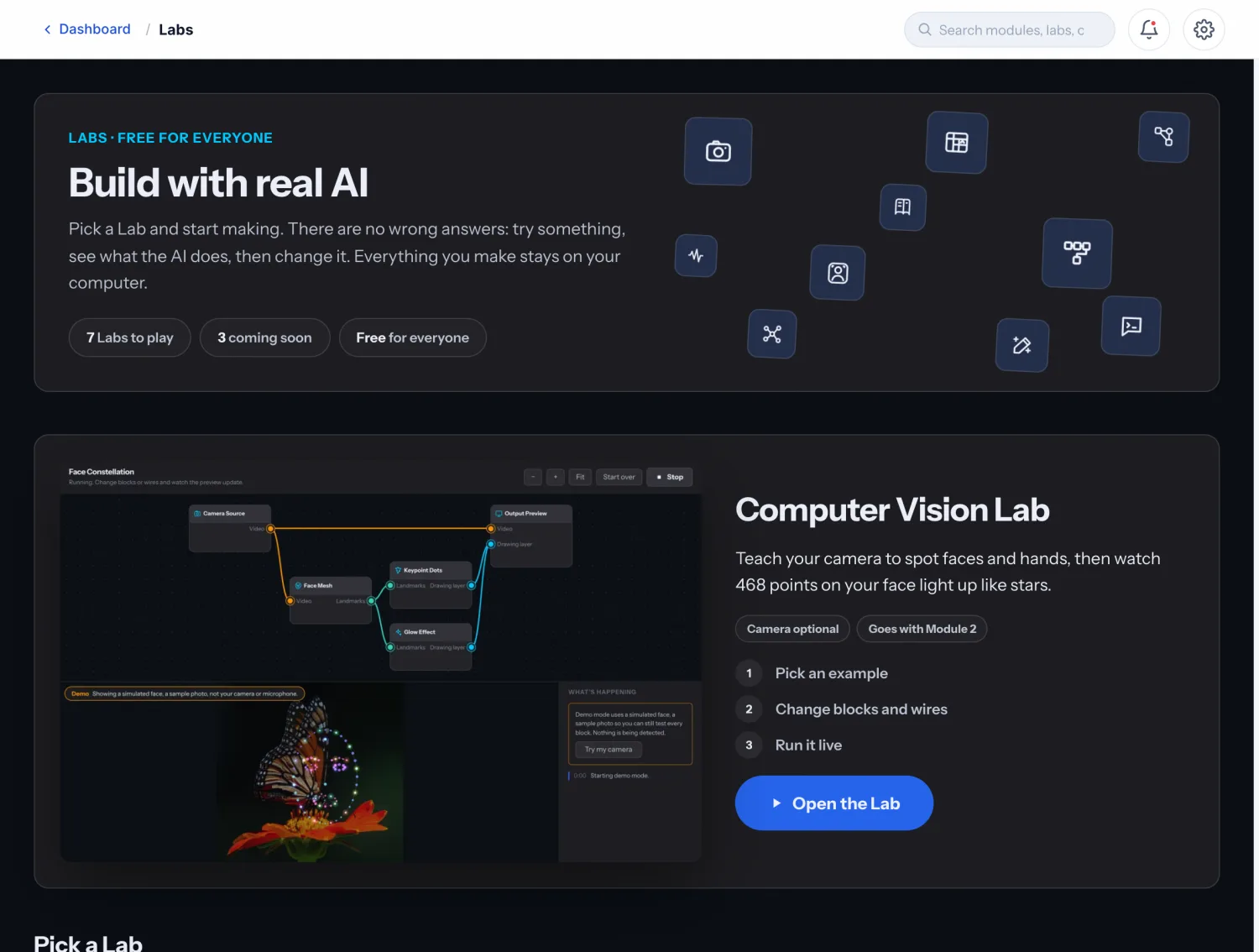
- The Labs, where learners build with real AI. The Computer Vision Lab's examples are free, and camera video is processed on the learner's own computer, never uploaded.
- A 3D Story Map of the curriculum, XP and stamps, Module quizzes, and an arcade of mini games that opens with XP earned by learning.
- Offline use after the first visit, on Windows, macOS, Linux and ChromeOS, including school-managed Chromebooks.
The premise: literacy as the capacity to examine
Literacy has always meant more than familiarity. A literate reader can ask who wrote a text, for whom, and to what end. AI literacy asks the same of a system: what it was trained on, what it was built to optimise, and where it is likely to fail. UNESCO's AI Competency Framework for Students (2024) describes a progression from understanding AI, to applying it, to creating with it, and it insists that the technical and the ethical are learned together. We read the framework closely in an earlier essay.
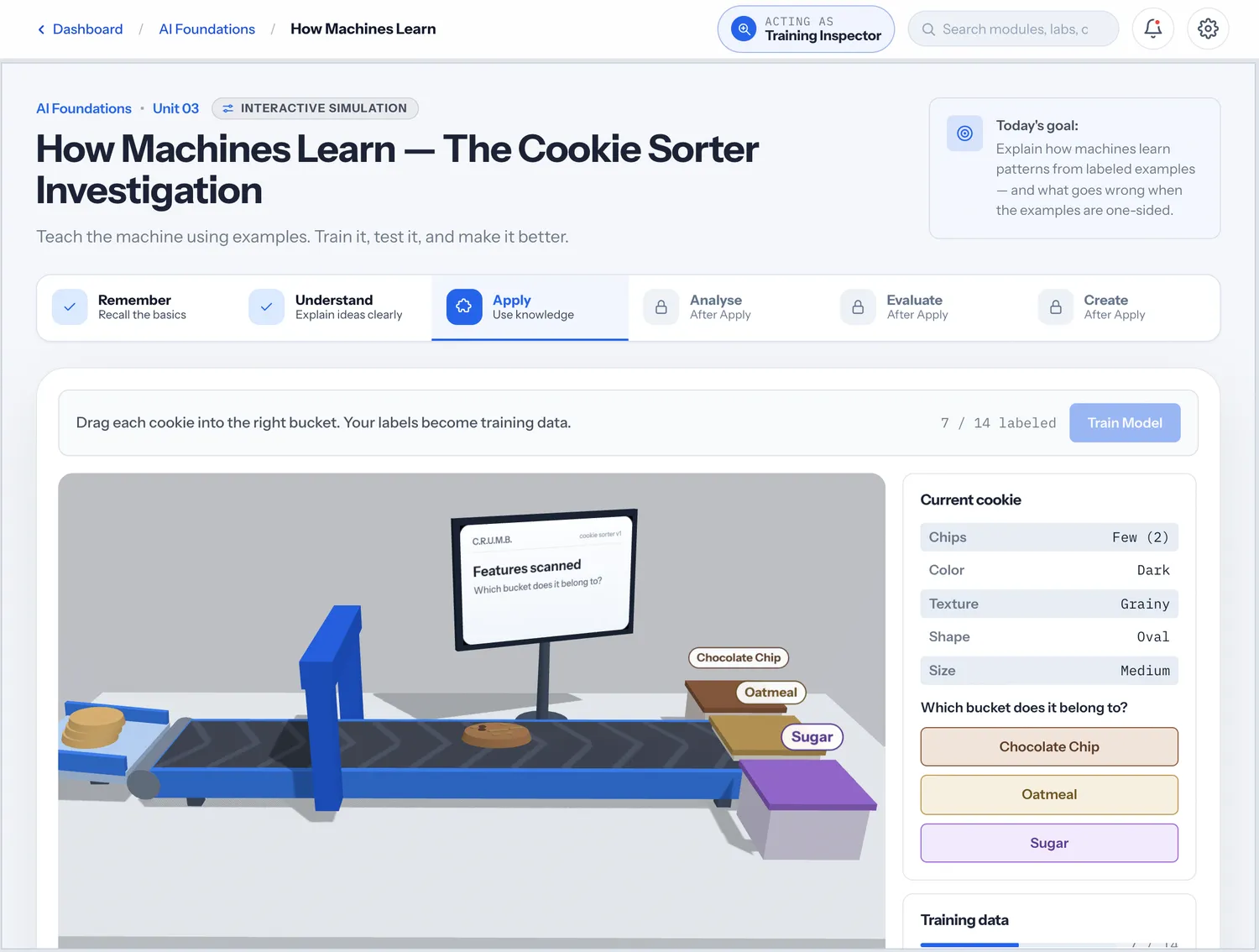
EdSutra's answer is simulation. Each Unit is a working model the learner operates, not a video to watch or a page to read. A Unit opens with a role (Training Inspector, for example) and climbs Bloom's taxonomy inside that one world: Remember, Understand, Apply, Analyse, Evaluate. Each step opens only when the learner has shown evidence in the step before. Creating happens in the Labs.
A learner should leave each Unit able to say not only what an AI system did, but why it did it, and what it would take to make it fail.
A first hour in the studio
We suggest starting with How Machines Learn, which is open from the first visit. The learner trains a machine to sort cookies, watches it pass its test, and then watches it fail on cookies it has never seen, because it learned a shortcut in the data rather than the rule anyone intended. Researchers call this shortcut learning. Learners usually call it unfair, and then they work out why. That moment, a prediction overturned by evidence, is the method of the whole curriculum.
Along the way, learners have company. Ada, a small pixel cat named after Ada Lovelace, celebrates finished Units, offers a guided tour, and points to the right Unit when one is not open yet. She is not a chatbot: every line she says was written by hand. The research behind her is in why our learning companion is a cat.
Four commitments
- Honest mechanisms. What a simulation shows is computed, not staged. Where a result would need a large model, we pre-author it and say so.
- Evidence before progress. Steps open on what the learner has shown, never on time spent or clicks made.
- Privacy as architecture. There are no learner accounts, no chat or social features, and no advertising. Progress is saved on the learner's computer; at unlock, an adult may choose to keep a small copy online so it follows the learner to their other computers.
- Ownership. One purchase, no subscription, nothing that renews, and a full refund within 14 days.
For families, homeschools and schools
Families can begin with Module 1 at no cost and decide afterwards. Homeschool families will find a suggested pace on the homeschool page, and the studio can be given as a gift. Schools and districts can arrange classroom licences, purchase orders and pilots through our schools team. The studio runs on desktop and laptop computers, including Chromebooks; it is not designed for phones.
What comes next
The curriculum will keep growing: new Units, new Labs, and applied tracks such as cybersecurity, sold separately when they are ready. Every change is recorded in the public changelog. We will also publish the reasoning behind the design here, beginning with an essay on Ada Lovelace and the first question of AI literacy.
If something does not work as it should, or a learner surprises you with what they worked out, write to us at help@edsutra.com. We read every message.
Open the studio and start with AI Foundations. It is free, and the first machine that is confidently wrong is only a few minutes away.
More from the EdSutra blog
- Why EdSutra's learning companion is a cat: the research behind Ada Learning Science · October 28, 2026
What four decades of research on learning companions suggest, and why EdSutra's companion is a scripted pixel cat rather than a chatbot. - Ada Lovelace and the first question of AI literacy History · October 28, 2026
In 1843 Ada Lovelace asked whether a machine can originate anything. Why her question is where AI literacy begins, and why our companion bears her name. - Introducing EdSutra Studio: a hands-on AI literacy studio in your browser Product · July 10, 2026
Interactive simulations, live labs, and a game-like curriculum that teaches how AI actually works — no installs, no accounts, one purchase. - UNESCO says every student needs AI competency. Here's what that actually asks of us Learning Science · July 6, 2026
A plain-language read of UNESCO's AI Competency Framework for Students: its four dimensions, three levels, and what they ask of curriculum builders. - Why most AI curricula fail the students they were written for Learning Science · June 28, 2026
Vocabulary lists, dated screenshots, and no machinery to touch: the three failure modes of first-generation AI literacy, and what to build instead. - Real AI labs, zero installs: why EdSutra runs entirely in your browser Product · June 20, 2026
Computer vision with your webcam, neural networks you can train, on-device models: all of it runs locally and offline, with nothing to set up. - Buy once, own forever: why EdSutra will never be a subscription Product · June 14, 2026
One payment for the core studio, optional expansions for applied tracks, and a promise: nothing you bought ever stops working. - Teach the history: why AI's past is the most useful lesson in the curriculum Curriculum · June 8, 2026
AI has boomed and crashed before. Students who know that history read today's headlines differently, so Module 1 opens with a map of where AI came from.