History
Ada Lovelace and the first question of AI literacy
By Dr. Sai Gattupalli · · 5 min read
In 1843 Ada Lovelace asked whether a machine can originate anything. Why her question is where AI literacy begins, and why our companion bears her name.
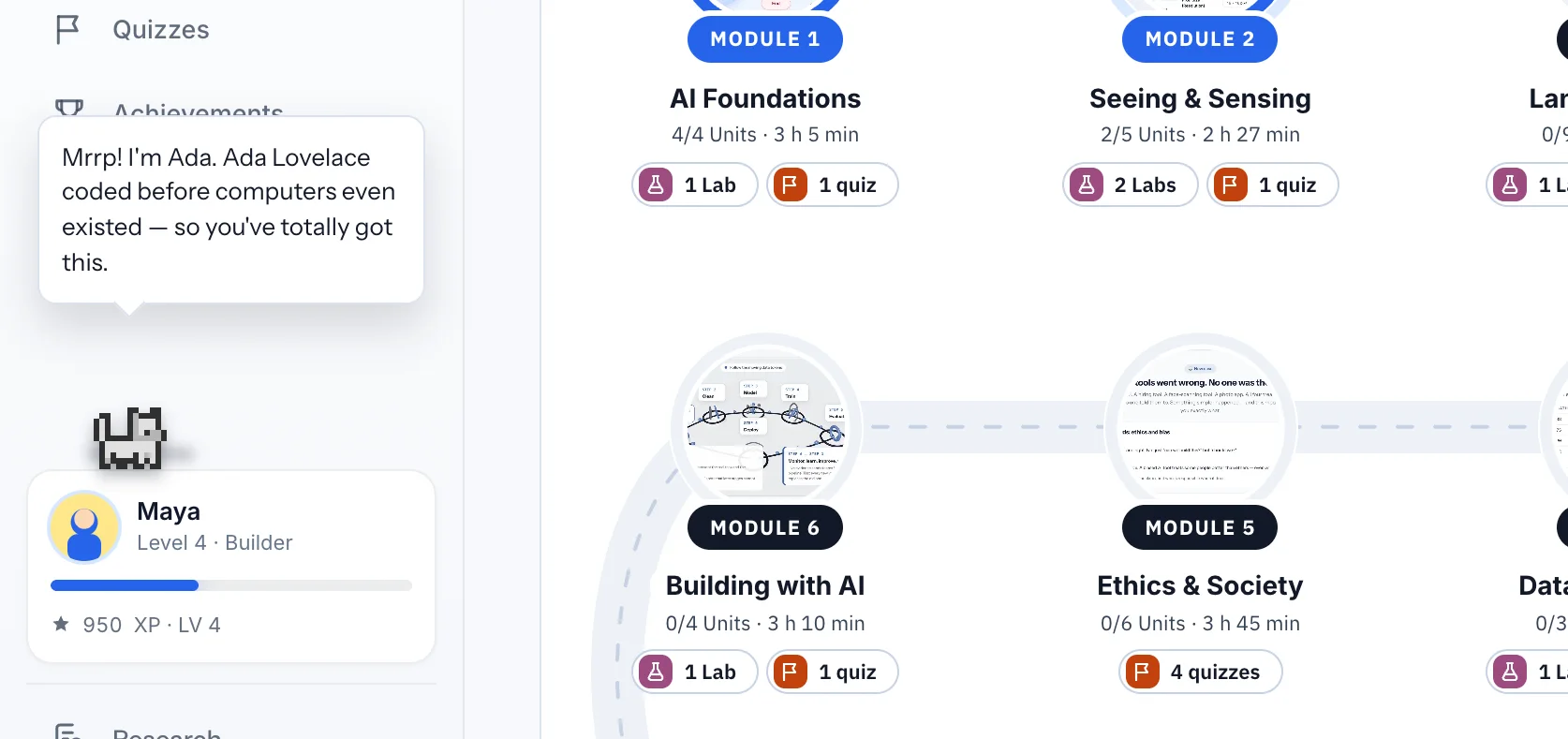
EdSutra's learning companion is a small pixel cat called Ada. The name is a dedication. Augusta Ada King, Countess of Lovelace (1815–1852), wrote the first extended account of what a general-purpose computing machine might do, and in the same pages she set down a caution about what it could not. Nearly two centuries later, that caution remains the most useful question a young person can bring to artificial intelligence.
A mathematical education
Ada Byron was born in London on 10 December 1815, the only legitimate child of the poet Lord Byron and the mathematically gifted Annabella Milbanke. Her parents separated weeks after her birth, and her mother saw to it that she was educated in mathematics and science. In June 1833, at seventeen, she met Charles Babbage and saw a working portion of his Difference Engine, a mechanical calculator. The meeting began a friendship and a collaboration that lasted the rest of her life.
Her mathematics was serious. In 1840 and 1841 she took a correspondence course with Augustus De Morgan, one of the leading mathematicians in Britain. The historians Christopher Hollings, Ursula Martin and Adrian Rice, working from the surviving letters, conclude that she had strong mathematical skills and an inquiring mind, and they correct earlier accounts that dismissed her ability.
The Notes of 1843
Babbage's more ambitious design, the Analytical Engine, was never built. It would have had a store for numbers, a mill for operating on them, and instructions supplied on punched cards borrowed from the Jacquard loom: in modern terms, a memory, a processor and a program. In 1842 the Italian engineer Luigi Menabrea, later prime minister of Italy, published an account of it in French. Lovelace translated the paper into English and added notes of her own. Published in 1843 in Taylor's Scientific Memoirs and signed only with her initials, A.A.L., the Notes run far longer than the paper they annotate.
The last of them, Note G, sets out in a table the sequence of operations by which the Engine could compute the Bernoulli numbers, a demanding series from number theory. It is usually described as the first published computer program. Historians add a qualification: Babbage had sketched programs for the Engine in his own unpublished papers some years earlier. What is new in the Notes is less the table than the vision around it.
Lovelace saw that the Engine's operations need not be confined to numbers. If the relations between symbols of any kind could be expressed in its notation, the Engine could act on them; it “might compose elaborate and scientific pieces of music of any degree of complexity or extent.” Her best-known image captures the idea:
The Analytical Engine weaves algebraical patterns just as the Jacquard-loom weaves flowers and leaves.
The objection
In the same Notes, Lovelace warned against overestimating the machine. Her sentence has become one of the most cited in the history of artificial intelligence:
The Analytical Engine has no pretensions whatever to originate anything. It can do whatever we know how to order it to perform.
In 1950, Alan Turing gave a section of “Computing Machinery and Intelligence”, the paper that proposed the imitation game, to what he called Lady Lovelace's Objection. His first reply was that machines take him by surprise often, because he cannot always foresee what follows from what he told them. His second reply looked further ahead. Instead of trying to program an adult mind, Turing suggested, we might build a machine resembling a child's mind and then educate it: a learning machine.
Three quarters of a century on, Turing's suggestion is the dominant method of the field. Modern AI systems are not ordered step by step; they are trained on examples, and no one writes their rules. Does that answer Lovelace? Only in part. A trained model can surprise its makers, in useful ways and in harmful ones, precisely because no one wrote its rules. Yet it originates nothing outside the data it was given and the objective it was set. Both statements are true at once, and holding them together is a large part of what it means to be literate about AI.
The first question of AI literacy
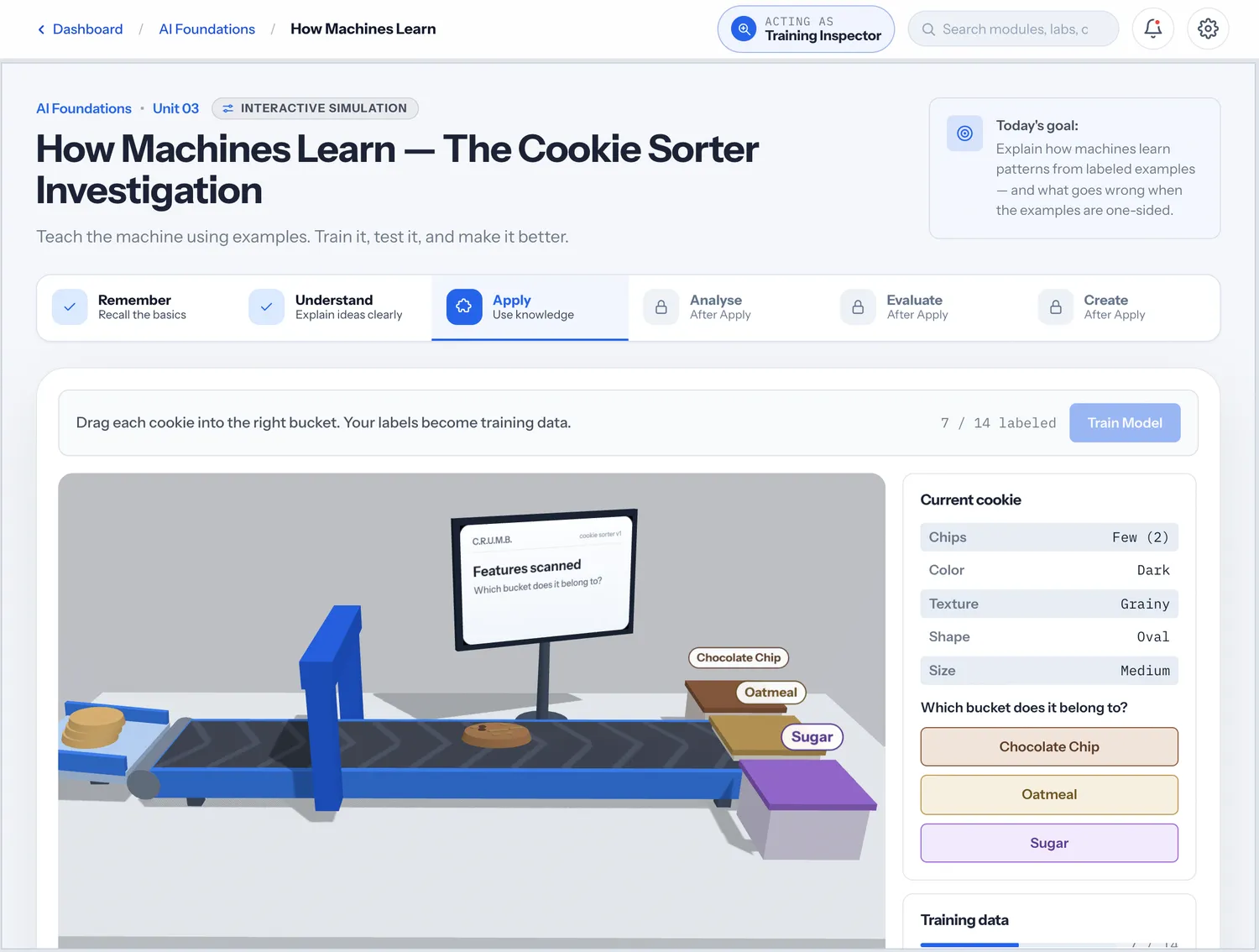
This tension is built into EdSutra's first simulation. In How Machines Learn, learners train a machine to sort cookies. It passes its test, then fails on cookies it has never seen, because it learned a shortcut in the data that nobody meant to teach. Nobody ordered that behaviour, as Turing would point out. And yet the machine invented nothing: the shortcut was in the examples all along, as Lovelace would reply.
Every Unit after that returns to some version of her question. What was this system ordered to do? What did it actually learn, and from what? When it seems to originate something, where did that originality come from? A learner who asks those three questions of any AI headline is already reading it more carefully than much of the commentary around it.
Why our companion carries her name
We named our companion Ada for three reasons. The first is her method. The Notes join imagination to rigour: a vision of machines composing music sits beside tables of operations worked out line by line. Curiosity disciplined by evidence is the habit EdSutra's simulations are built to train.
The second is her scepticism. Lovelace was among the first people to think seriously about a computing machine, and among the first to warn against claiming too much for one. Her caution is the posture we hope learners bring to every confident claim about AI, including the confident claims AI systems make about themselves.
The third is that she was a young learner herself. She was seventeen when she first saw Babbage's engine and twenty-seven when her Notes appeared. A student meeting AI for the first time is closer to that young woman than to the legend, and we would like every learner, especially those who have seldom seen someone like themselves in the history of computing, to recognise themselves in her story.
Ada the cat is not a portrait of Ada Lovelace, and she claims none of her intelligence; as we explain in why our learning companion is a cat, she is not an AI at all. She is a reminder. When she tells a learner that Ada Lovelace “coded before computers even existed”, she is pointing to a person who looked hard at a machine and described, with equal care, both what it might do and what it could not.
A note on legend
Lovelace is often called the first computer programmer, and the title is contested; we say “often called” deliberately. The evidence supports a more precise claim. Her Note G is the first published algorithm written for a general-purpose computing machine, and her Notes are the first sustained reflection on what such a machine could and could not do. That precise claim is remarkable enough. Separating a careful claim from a convenient legend is, after all, exactly the skill AI literacy asks of us.
Her name has since been given to a programming language, Ada, standardised for the United States Department of Defense in 1980 as MIL-STD-1815, the number taken from the year of her birth. It is also carried by Ada Lovelace Day, held each October to celebrate women in science, technology, engineering and mathematics.
References
- Fuegi, J., & Francis, J. (2003). Lovelace & Babbage and the creation of the 1843 ‘notes’. IEEE Annals of the History of Computing, 25(4), 16–26. https://doi.org/10.1109/MAHC.2003.1253887
- Hollings, C., Martin, U., & Rice, A. (2017). The early mathematical education of Ada Lovelace. BSHM Bulletin: Journal of the British Society for the History of Mathematics, 32(3), 221–234. https://doi.org/10.1080/17498430.2017.1325297
- Hollings, C., Martin, U., & Rice, A. (2018). Ada Lovelace: The making of a computer scientist. Bodleian Library.
- Menabrea, L. F. (1843). Sketch of the Analytical Engine invented by Charles Babbage (A. A. Lovelace, Trans., with notes by the translator). Scientific Memoirs, 3, 666–731.
- Turing, A. M. (1950). Computing machinery and intelligence. Mind, 59(236), 433–460. https://doi.org/10.1093/mind/LIX.236.433
More from the EdSutra blog
- EdSutra Studio is now open to everyone Product · October 28, 2026
EdSutra Studio's public release: a simulation-based AI literacy curriculum for ages 11 and up. Module 1 is free; the full studio is one purchase. - Why EdSutra's learning companion is a cat: the research behind Ada Learning Science · October 28, 2026
What four decades of research on learning companions suggest, and why EdSutra's companion is a scripted pixel cat rather than a chatbot. - Introducing EdSutra Studio: a hands-on AI literacy studio in your browser Product · July 10, 2026
Interactive simulations, live labs, and a game-like curriculum that teaches how AI actually works — no installs, no accounts, one purchase. - UNESCO says every student needs AI competency. Here's what that actually asks of us Learning Science · July 6, 2026
A plain-language read of UNESCO's AI Competency Framework for Students: its four dimensions, three levels, and what they ask of curriculum builders. - Why most AI curricula fail the students they were written for Learning Science · June 28, 2026
Vocabulary lists, dated screenshots, and no machinery to touch: the three failure modes of first-generation AI literacy, and what to build instead. - Real AI labs, zero installs: why EdSutra runs entirely in your browser Product · June 20, 2026
Computer vision with your webcam, neural networks you can train, on-device models: all of it runs locally and offline, with nothing to set up. - Buy once, own forever: why EdSutra will never be a subscription Product · June 14, 2026
One payment for the core studio, optional expansions for applied tracks, and a promise: nothing you bought ever stops working. - Teach the history: why AI's past is the most useful lesson in the curriculum Curriculum · June 8, 2026
AI has boomed and crashed before. Students who know that history read today's headlines differently, so Module 1 opens with a map of where AI came from.